What are your thoughts about Michael Brown and the events in Ferguson, MO?

Dear Dwonna:

What are your thoughts about what’s going on in Ferguson, Missouri?

Signed,

Winn

———————————–

Dear Winn:

As some of my Facebook friends might have noticed, I have stayed away from commenting on what has happened—and continues to happen—in Ferguson, Missouri. For those who may have missed this, here’s a little bit of background:

On August 9, 2014, an unarmed 18-year-old African American named Michael Brown was fatally shot by Darren Wilson, a white police officer, in Ferguson, Missouri, a predominately African American suburb of St. Louis. A private autopsy performed by Dr. Michael Baden (the former chief medical examiner for the City of New York) showed that Brown was “shot as least six times, including twice in the head.” According to the New York Times, one of the bullets “entered the top of Mr. Brown’s skull, suggesting his head was bent forward when it struck him and caused a fatal injury.” Brown was also shot four times in the right arm, and “all the bullets were fired into his front.”

Unfortunately, Brown is not the only unarmed black man to be killed by a white police officer in the last 30 days. On July 14, 2014, 43-year-old Eric Garner was killed after a cop put him in a chokehold and other officers slammed his head against a sidewalk. At least five NYPD officers took down Garner—a 400-pound asthmatic Staten Island father of six and grandfather of two—“when he balked at being handcuffed” in front of a Tompkinsville beauty supply store. (Police say that they were attempting to arrest Garner for illegally selling cigarettes.) “I can’t breathe! I can’t breathe!” Garner screamed at the cops, and within moments, he had “stopped struggling and appeared to be unconscious as police called paramedics to the scene.” An angry crowd recorded the incident with their smartphones.

While Garner’s death set off a series of protests against the NYPD, Brown’s killing led to two weeks of demonstrations, riots, and looting. The day after Brown’s death, demonstrators held a candlelight vigil to honor him, but instead it turned violent. More than a dozen businesses were vandalized and looted, cars were vandalized, and some 30 people were arrested and two police officers were injured. Throughout the two weeks of protests and demonstrations, police wearing riot gear used tear gas and rubber bullets to try to disperse the large crowds that had gathered. The unrest and chaos became so untenable that on August 18, Missouri Governor Jay Nixon ordered the Missouri National Guard to Ferguson to protect the “Unified Command Center so that law enforcement officers could focus on the important work of communicating with the community, restoring trust, and protecting the people and property of Ferguson.”

There are many, many problems with what happened in Ferguson, beginning with the shooting of an unarmed black teenager by a white policeman and the tomfoolery of protesters in Michael Brown’s name. The fact is that officer Darren Wilson and the mostly white police force—only 3 of the 53 officers are black in a city that is 67 percent black—are only party to blame. Rightfully so, the police in Ferguson have come under sharp criticism for their handling of the aftermath of the shooting and death. In the first days of the demonstrations, police attempted to smear Brown’s name by suggesting that he had stolen $50 worth of cigars from a convenience store, but later they had to admit that Officer Wilson did not know that Brown was a suspect in this theft. Police also made “mass arrests” and used “heavy-handed tactics and military gear widely seen as provoking more anger and violence by protesters.”

Yes, police showing up in riot gear may not have been the best strategy. Washington Post reporter Wesley Lowery said one man in Ferguson told him, “When I go somewhere and see a cop in riot gear, first thing I think is, ‘Riot.’ When I see someone that looks like they’re ready to fight me, I’m going to put up my fists.” The head of Ferguson’s police department did change their tactics, and he said that officers would “facilitate” demonstrations rather than “restrict” them. “With the chaos that’s going on right now,” Ferguson Police Chief Thomas Jackson said, “I’m at least happy that nobody’s gotten seriously injured.” It is very difficult to “defuse tension in the streets” when the police are “hardened up.”

Many people blamed the violence and looting in Ferguson not on the police but on “intentional provocateurs” and “outside infiltrators.” Although members of the New Black Panther Party and the Nation of Islam showed up to demonstrate, former leader of the New Black Panther Party Malik Zulu Shabazz said that he and his group were “peacemakers” in Ferguson. “My group and—thanks to you—my organizers, along with the New Black Panther Party and the Nation of Islam,” Shabazz said during a news conference held by Missouri Highway Patrol captain Ron Johnson. “We are the ones who put those men in the streets, and we controlled the flow of traffic.” Johnson did agree that Shabazz and his group had helped out during the demonstrations.

Too many of the protesters were from cities other than Ferguson, and too many of them lost focus about why they were there—to ask for a fair and impartial investigation for Michael Brown and his family. However, we still don’t know why Darren Wilson shot Michael Brown, and speculation that Brown went for the officer’s gun is just that…speculation. Being a police officer is hard, and they have to make snap judgments that most of us will never understand. Is Officer Darren Wilson a racist simply because he shot an unarmed black teenager? I don’t know, and neither do the protesters.

What should black America do when a white police officer shoots an unarmed black person, something that happens far too often in this country? Rioting and looting and behaving like scalawags should be at the bottom of that list; asking Al Sharpton and his cronies to stay home should be at the top of that list. However, I can’t help but believe that the mostly African American crowd of protesters is simply reinforcing negative stereotypes that too many white people embrace about us. Holding demonstrations and protesting the killing of the unarmed Michael Brown is admirable and necessary; looting and vandalizing businesses and cars is destructive and counterproductive. As Jonathan Jeans, an African American graduate of Austin Peay State University, wrote on his Facebook wall in response to the events in Ferguson: “I think we should all work hard to change the minds of our fellow countrymen by casting down and proving wrong the stereotypes that plague our society. We must remain cognizant of the fact that they do exist within our society.”

I wish the media would talk more about the good things that black folks are doing, instead of focusing on the miscreants in Ferguson. Let’s spend more time talking about the 11- and 12-year-old baseball players from Jackie Robinson West, the Little League team from Chicago, Illinois, that represented the United States against Korea in the 2014 Little League World Series. The all-black squad is a member of the Urban Initiative, a program that supports Little League programs in “needy urban areas,” and its members all hail from the South Side, one of the most distressed neighborhoods in Chicago. “The city of Chicago could not be prouder of them,” Chicago mayor Rahm Emanuel has said. “Their positive attitude and success on the field has rallied people from every neighborhood to support these kids, and they continue to demonstrate why they are the pride of Chicago.” Although Jackie Robinson West lost to Korea 8-4, we should be spending more time and energy praising the good works and sportsmanship of these young men.

Dr. Cornel West—a professor of philosophy in the Center for African American Studies at Princeton University and a prominent member of the Democratic Socialists of America—has been critical of President Obama’s “slow” response to Brown’s killing. For West, Obama’s public statements on the events in Ferguson were “motivated by electoral considerations rather than moral beliefs.” “His words reek of political calculation rather than moral conviction,” he said. West also said that it was “disgusting” to have a black president who is “not able to keep up with what was going on with young black youth.”

What too often is “going on with young black youth” in this country is the antithesis to a successful life. According to the latest government statistics, African American women had the highest rate of out-of-wedlock births at 67.8 percent, though this does includes women who may be living with—but not married to—the baby’s father. CNN anchor Don Lemon, during an on-air commentary following George Zimmerman acquittal in 2013, said that in order for black people to “fix the problems in the black community,” the “most important” item to fix was the number of children born to unmarried women. “Just because you can have a baby, it doesn’t mean you should,” Lemon said. “Especially without planning for one or getting married first. More than 72 percent of children in the African-American community are born out of wedlock. That means absent fathers. And the studies show that lack of a male role model is an express train right to prison and the cycle continues.”

The black community must remain vigilant in urging young black women to wait to have children and to stay in school, and we must urge young black men to delay having children and to stay in school, too. I’ve read that people have asked students to skip class on Monday, the day of Michael Brown’s funeral and what would have been his first day of college classes. Would we not better honor Brown’s life and his tragic death by asking ALL students to go to class?

I’m not sure I’ve answered your question, Winn, mostly because I’m not really sure what my thoughts are on what happened in Ferguson. We don’t have enough information to make an informed conclusion since there has been little transparency from the Ferguson Police Department. In contrast, NYPD Training Commissioner Ben Tucker ordered a “top to bottom review of all the training that his department provides to its personnel, specifically focusing on force, how do we train our officers for a takedown, [and] how do we train them to use the various levels of force that they’re authorized to use.” “I would anticipate that coming out of this effort that there will be a re-training of every member of the New York City Police Department in the weeks, months and potential years ahead,” NY City Police Commissioner William Bratton said. Still, white America should not stand idly by when the Michael Browns and Eric Garners are tragically killed by white police officers, and they should join African Americans in demanding that a full investigation be fairly and swiftly adjudicated. The black community, too, must do a better job of making sure we hold our young men and women to high standards, and we should support them in making moral and honorable choices that will facilitate a successful transition into adulthood.

On Monday, August 25, thousands of mourners filled the Friendly Temple Missionary Baptist Church in St. Louis for Michael Brown’s funeral. His father asked protesters to observe a “day of silence” so that the family could grieve their “gentle giant.” “Tomorrow all I want is peace,” Brown Sr. told hundreds of people at a festival in St. Louis that promotes peace over violence. “That’s all I ask.” Let’s hear—and heed—the cries of Michael Brown’s family, and let’s make sure that their son did not die in vain. Let Michael Brown and Eric Garner teach us how to better deal with police, and let’s hope their tragic deaths teach the police how to better deal with us.

mikebrown_t750x550


Are people who commit suicide selfish and cowards?

Dear Dwonna:

What do you think about Fox News anchor Shephard Smith’s comment that Robin Williams was a “coward” for committing suicide and Todd Bridges’s Tweet calling Williams’s suicide “a very selfish act”? Do you think people who commit suicide are cowards and/or selfish?

Signed,

Patrick

————————————————–

Dear Patrick,

First, a little bit of background on the story:

On Monday, August 11, at 11:45 a.m., actor and comedian Robin Williams—best known for his roles in “Mork and Mindy,” “The Crazy Ones,” “Good Morning Vietnam,” “Dead Poets Society,” and “Mrs. Doubtfire,” among others—was found unresponsive at his home in Tiburon, California, by his personal assistant. He had “a belt secured around his neck,” Marin County Sherrif’s Lt. Keith Boyd told reporters in a press conference the following day. The official cause of death has been revealed as “asphyxia due to hanging.”

Mere hours after the news of Robin Williams’s tragic suicide was made public, Fox News report Shephard Smith called Williams a “coward” for taking his own life. “One of the children he so loved, one of the children grieving tonight,” Smith said. “Because their father killed himself in a fit of depression.” “…[S]omething inside you is so horrible or you’re such a coward or whatever the reason that you decide that you have to end it. Robin Williams, at 63, did that today,” Shephard concluded.

Todd Bridges—star of the television show Diff’rent Stokes—used Twitter to call Williams’s suicide “a very selfish act.” “It’s a very selfish act you’re not thinking about your family your friends or your fans,” Bridges wrote. “much better way get help or if you know someone like that get them help even if it means getting them locked up in a psychiatric hospital.” (The grammatical errors are Bridges’s and not mine.) Both men have since “apologized” for their “inconsiderate” comments.

As someone who is a survivor of suicide—my 42-year-old brother took his own life on May 4, 2010—all I want to say to Shephard Smith and Todd Bridges is “WOW.” (Well, really I’d like to yell “WTF!!!”) That two men—one of whom (Bridges) has publically battled his own demons (drugs and alcohol) which earned him multiple stints in jail/prison—would be so callous and judgmental about another man’s struggles with depression is repulsive (though in the case of the Fox New reporter certainly not surprising). Like cancer and diabetes, depression is a real illness, and people need to get educated about the very real effects of the disease before they start taking to television and to Twitter to pass judgment on an act that many of us could never envision for ourselves.

Do I think that Robin Williams—or my brother or the other 50,000 Americans who successfully complete suicide in any given year—was a coward or selfish? I answer that with an emphatic “NO.” As I learned in my Survivors of Suicide (SOS) support group, people who commit suicide don’t necessarily want to die; they just want the pain to end. For these people, their despair is overwhelming, and suicide seems to be the only option left. Completing suicide does not make them cowards; it makes them people who are in so much agony and distress that death becomes the only relief available. As Sally Brampton writes in Shoot the Damn Dog: A Memoir of Depression, “Killing oneself is, in a way, a misnomer. We don’t kill ourselves. We are simply defeated by the long, hard struggle to stay alive.”

Like other people, I wish that Robin Williams, my brother, and all those who have suicided knew how much they mattered to the friends and family they left behind. I wish they knew how much they were loved. I wish they knew how much we would miss them. However, those who suffer with severe depression often cannot comprehend that at all, and they are not selfish because they are unable to see beyond their own deep and intense pain. They are simply people who need our compassion, not our derision and disrespect.

At the end of my first SOS meeting, the elderly facilitator discretely handed me a 3×5 notecard on which he had handwritten: “My hope is that one day you will no longer just remember how your loved one died but that you will only remember how well he or she lived.” I’m not yet there with my brother, but I do reminisce about our life together more often than I think about how his life ended. My hope is that Robin Williams’s suicide will compel us to have a more public—and a more honest and a more knowledgeable—dialogue about depression and suicide and a less judgmental attitude toward those for whom suicide was the only way to end their despair.

God 

*If you or someone you know is suicidal, there is help available. Please call the Suicide Prevention Hotline at (800)273-8255. You do matter, you are loved, and you will be missed.

My boyfriend drinks too much; what should I do?

Dear Dwonna:

I’m a 44-year-old woman, and I think my boyfriend of almost three years is an alcoholic He’s 50 and never drinks during the week, but he likes to drink on the weekends. Most of the time he’s easy to get along with, but sometimes he becomes a mean drunk. He always apologizes on Monday when I point out that his bad weekend behavior, and although this helps for a few weeks or so, it eventually happens again. I love him and hope to one day marry him, but I’m not so sure I can do that if this weekend binge drinking continues. What should I do? Thanks!

Signed,

Trina

——————————————-

Jennifer Cooper, a recovering addict, answered this question for me. 

Dear Trina,

Reading your question took me back many years. Let me first say that I have been on both sides of the alcohol issue. I am a recovering addict of 27 years, and I was married to an abusive alcoholic for five of them.

The first thing you need to realize is that your boyfriend may be an alcoholic, but until he can or will admit it, there is absolutely nothing you can do to “fix” the situation. (Trust me; I’ve tried it myself.) Addiction is an illness. You may hear about treatment centers that say they can “cure” an alcoholic, but it’s a lie if that person does not want help. I am an addict. I will always be an addict. However, with hard work and daily commitment, I am able to live a relatively normal life.

Still, my addiction sometimes feeds my brain lies. You see, Trina, being an addict isn’t just about drinking or taking drugs; it’s a mental state that my brain enters telling me that that I “NEED” something. That something can be alcohol, drugs, cigarettes, gambling, sex, or a multitude of other things. The process is strange when the addict quits the object of his addiction.

For example, my brain tried to convince me I couldn’t function without drugs or alcohol. I had trouble doing everyday tasks as my brain went through withdrawal and told me I couldn’t walk, read, or even breathe correctly without the drugs. For me to heal completely, I needed to be addicted to something positive—I am 44 and working on two masters degrees while I work full time. I am now addicted to my education. When I finish schooling, I will have to find something else to latch on to.

You mention that your boyfriend can be a “mean drunk.” If this means he hits you, then get out immediately! I was in that situation for five years. I heard the apologies and thought it might somehow magically get better, but it never did. For five long years there were earth shattering fights as he pummeled me over and over again, somehow making his drinking my fault.

In the midst of my own addiction, I thought that I could fix my husband. I believed that if only he would stop drinking everything would be fine. I must have made him angry to drink so much, to spend the rent money, to not come home for days on end, to hit me, to lose job after job, etc. By making excuses for him, I was feeding my own addiction.  

I hung on for all I was worth. My parents and friends saw the bruises—both physical and emotional—and they pleaded with me day after day to leave him. I was afraid. I was afraid I wasn’t strong enough, smart enough, independent enough, and that I couldn’t make enough money. When I mentioned leaving him, he threatened to hunt me down and kill me. Eventually, I got sick and tired of being sick and tired. Facing a life of misery, abuse, and isolation, I knew it was time to get out, and I did finally leave him. He did make good on his threat and came after me, but he was too drunk to fire the gun.

The best advice I can give you is if you really think your boyfriend needs help, get to some Al-Anon meetings. These meetings are free, confidential, and supportive. The people in these meetings are all at some stages of life that involve dealing with an alcoholic partner, parent, sibling, or friend, and they will offer you advice. You can take what you want and leave the rest behind. They can offer you support, too, but you have to pick up the phone and call. If you go to Al-Anon, you will not be alone.

I do understand that dealing with an addict is tricky. We want to support them and love them, but by making excuses for them, we are actually making it easier for them to continue the behavior we do not like. If you are making excuses for him now—e.g., he only drinks on weekends, he promises not to hit me anymore, it was better for a few weeks—you are not promoting the change that you hope to see.

Tough love is one of the hardest things anyone can practice, and standing up to someone we love and telling them that their behavior is unacceptable seems overwhelming. However, it must be done, though do not have this conversation when your boyfriend is drinking.

Keep in mind that if he quits drinking for you that there’s a good chance that he will start again. The fact is that your boyfriend has to WANT to quit drinking to actually quit drinking permanently. My husband quit for weeks at a time, and at the next spat we had, he’d go back to drinking again and then it was my fault he couldn’t stay sober. Don’t fall into the alcoholic’s traps.

Do beware the apologetic drunk! During one of my ex-husband’s apologies and shame, he attempted suicide. The hospital called me while I was at work, but I didn’t go visit him until I had gone to an Al-Anon meeting myself. He had taken a bottle of pills and called 911 because my ex-husband really didn’t want to die; he just wanted me to feel so bad that I would take him back. Later, I walked into his hospital room and hit him over the head with my Narcotics Anonymous book and told him he was a “Sorry selfish son of a ……” (you get the idea!)

I also told him that if he ever wanted to try to pull such a stunt again that he should let me know ahead of time so I could help him get it right! He was shocked and actually started to go to AA meetings. I was elated because I had changed him! Boy was I wrong. Soon after, he met up with an old friend and the “just have one” kicked in. He was drunk and beating me again shortly thereafter.

I suggest moving out if you live together. This does not mean you cannot be there to support him if he does quit drinking on his own. However, if he enters a 12-step program, he will be encouraged not to have a serious relationship for at least a year. This does not mean you cannot communicate with him; just support him and be his friend. (Be only this friend, though.)

Please seek some form of help for your situation. If you cannot find an Al-Anon meeting that fits you, try Nar-Anon. To find meetings in your area, you can go to these links:

  1. aa.org
  2. Al-Anon.org
  3. na.org
  4. nar-anon.org

If you do not have transportation to get to a meeting, call the local number for the group, and they will find someone to give you a ride.

Good Luck!

Jennifer Cooper

Jennifer C.2

What I’ve Learned About Life From Air Supply

Dear Dwonna:

You’re always telling your students how much you love Air Supply and Barry Manilow and other “old people” music. What lessons about life have you learned from these songs?

Signed,

Brenda

—————————————-

*Brenda Ford asked me this question, and she helped me write this answer, too. Brenda and I attended Butterworth Elementary, we played softball together in the summers (I played short stop), and we also went to Moline High School. Thanks, Brenda, for helping me write this!

Dear Brenda:

Yes, it’s true that I love Air Supply, Billy Joel, Lionel Richie, Barry Manilow, Neil Diamond, James Taylor, Barbara Streisand, Chicago, Leo Sayer, “The Golden Girls,” “Matlock,” “Murder, She Wrote,” “Diagnosis Murder,” “9 to 5,” and “Snapped.” If it’s something that old white women watch or listen to, I probably like it, too.

The truth is that I’m secretly an old white woman trapped in the body of an angry (but very cute) black woman who also masquerades as a professor of English and African American studies. I’m afraid that the black card will be in jeopardy again by the time I get to the end of this essay. Sigh.

But, I digress. Here are 13 songs from Air Supply, Lionel Richie, and other “old white lady” music that explain what I’ve learned about life. Some of the topics overlap, but love and kindness seem to be persistent themes of this “easy listening” music.

1.     Lionel Richie and Diana Ross, “Endless Love

“And love/Oh, love/I’ll be fool/For you,/I’m sure/You know I don’t mind/Oh, you know I don’t mind”

Listen, we’ve all been a fool for love at least once, and we all thought that we, too, would find endless love. This happens for some, but for many of us, love eludes us, and we sometimes make fools out of ourselves in the process. It’s ok, though. Love with a good person is a wonderful thing to find, and even if the love isn’t endless, always cherish the good times that you had with that person. As Oscar Wilde once said, “Keep love in your heart. A life without it is like a sunless garden when the flowers are dead.” Heartbreak sucks, but endless love is wonderful and worth the search.

2.     Chicago, “Hard to Say I’m Sorry”

“Hold me now/It’s hard for me to say I’m sorry/I just want you to know/Hold me now/I really want to tell you I’m sorry/I could never let you go”

Yes, sometimes it’s hard to tell someone you’re sorry, and sometimes it’s the most difficult thing for the strongest people to say. However, if you’re wrong and you know you’re wrong, say you’re sorry. I know, from personal experience, that nothing sucks more than realizing that you’re wrong in the middle of an argument. Apologize anyway. It’s the right thing to do, and it doesn’t make you weak—it makes you humble AND vulnerable AND courageous. Saying you’re sorry can repair a relationship, and even though “sorry seems to be the hardest word” (Thanks, Elton John!) it’s oftentimes what needs to be said when there is nothing else left to be said.

3.     Billy Joel, “And So It Goes”

“In every heart there is a room/A sanctuary safe and strong/To heal the wounds from lovers past/Until a new one comes along”

Few of us will escape this life without someone breaking our heart (even I’m still a little bit heartbroken about my first college boyfriend), and it makes sense to protect yourself from getting your heart broken again. Still, be open to finding new love, but be smart. Pick a nice person with little baggage and a kind heart, and treat this person kindly and gently. “The truth is,” Bob Marley once said, “everyone is going to hurt you. You just got to find the ones worth suffering for.” Don’t close your heart completely, for it might miss the one who may fill it with love and happiness. Cheesy and trite, I know, but it’s true.

4.     James Taylor, “You’ve Got a Friend”

“You just call out my name, and you know wherever I am/I’ll come running to see you again./Winter, spring, summer, or fall, all you have to do is call, and I’ll be there, yeah yeah yeah/You’ve got a friend”

I’ve had some really good friends who were there for me even when I wasn’t very pleasant to be around, and I will forever be grateful to these people for helping me through difficult times. (Thanks Blas and Neil and Paul and all the other gays who have one-upped my fabulous stories of debauchery!) Find the people who will be there for you when things get tough, and be that friend for whom others can turn to when things get tough for them. As Dean Koontz writes, “Never leave a friend behind. Friends are all we have to get us through this life—and they are the only things from this world that we could hope to see in the next.”

Finding the right friends can be essential to your health, happiness, and growth. Choose friends who won’t just tell you what you want to hear but who will tell you what you need to hear even when you want to stay in your fantasyland of unwise choices. Finally, always remember Barbara Kingsolver’s words: “The friend who holds your hand and says the wrong thing is made of dearer stuff than the one who stays away.” When you do find that kind of friend, hold on to her for dear life.

5.     Air Supply, “What a Life”

“I don’t care about the money I make/Or what it can do/I’m alive and that’s/What’s important to me”

My students never believe me when I tell them that Air Supply is probably my most favorite group, and I’m a huge fan of—and know all the lyrics to—their more well-known songs: “I’m All Out of Love,” “Here I Am,” “Making Love Out of Nothing At All,” “Even the Nights are Better,” “Young Love,” “Lost in Love,” and “Two Less Lonely People in the World.” But, I like this not-so-commercially popular song, too.

Create a life that is meaningful for you, even if it means you won’t get wealthy. Steve Jobs said, “Your work is going to fill a large part of your life, and the only way to be truly satisfied is to do what you believe is great work. And the only way to do great work is to love what you do. If you haven’t found it yet, keep looking. Don’t settle.” Find a job you love, and don’t settle for a job just because it will make you rich.

Don’t become obsessed with making a lot of money, though do try to make enough money so that you and your family can live comfortably. And, even if you hate your job, find the good in it and be grateful that you have something to do. Find what’s important to you, and spend more time doing that. As Mark Twain once said, “Do the right thing. It will gratify some people and astonish the rest.”

6.     Culture Club, “Karma Chameleon”

“I’m a man without conviction/I’m a man who doesn’t know/How to sell a contradiction/You come and go/You come and go/Karma Karma Karma Karma Karma Chameleon”

I’m not going to lie, but I had absolutely no idea what this song is supposed to mean, so I looked it up on that trusty website called Wikipedia (a site that I forbid my students from using by telling them that I will immediately fail them if I find that they have cited it). Anyway, according to Wikipedia, Boy George—the cross-dressing lead singer of Culture Club—said, “The song is about the terrible fear of alienation that people have, the fear of standing up for one thing. It’s about trying to suck up to everybody. Basically, if you aren’t true, if you don’t act like you feel, then you get Karma-justice, that’s nature’s way of paying you back.”

Who knew that Boy George was such a philosopher? He may not be Aristotle or Socrates or Confucius, but he’s right nonetheless. We all have a responsibility to be true to ourselves, but in doing this, we must always remain gentle and compassionate to the world around us. “If you want others to be happy,” the Dalai Lama tells us, “practice compassion. If you want to be happy, practice compassion.”

Free yourself from resentful thoughts so that you, too, might find peace. Be kind. As Philo said, “Be kind, for everyone you meet is fighting a hard battle.” (A Facebook meme I just saw said, “Everyone is fighting their own battles. Try not to be an asshole.”) Your kindness will never be wasted because, as Barbara DeAngelis says, “They bless the one who receives them, and they bless you, the giver.”

I think Wayne Dyer’s quote best sums up my views about karma: “How people treat you is their karma; how you react is yours.” Now go into the world and be kind. And behave yourself.

7.     Michael Bolton, “When I’m Back on My Feet Again”

“Gonna break from these chains around me/Gonna learn to fly again/May be hard, may be hard/But I’ll do it/When I’m back on my feet again/Soon these tears will all be dryin’/Soon these eyes will see the sun/Might take time, might take time/But I’ll see it/When I’m back on my feet again”

This is not my all-time favorite Michael Bolton song—“That’s What Love is All About” and “How Am I Supposed to Live Without You” are my two favorites—but this one is a solid third. Life will knock you down, and sometimes after you get up, it will knock you back down again. Get. Back. Up. Every. Time.

An old Irish proverb says, “There’s nothing so bad that it couldn’t be worse.” Sometimes when you’re in the midst of something awful, you will convince yourself that it can’t get any worse, and most of the time it really can’t—and won’t—get any worse. Go figure out what you need to do differently, and then take the steps to do something different and be different.

“In order to succeed, your desire for success should be greater than your fear of failure,” America’s black father Bill Cosby once said. You will get back on your feet. Listen to Mr. Cosby.

8.     Bobby Brown, “My Prerogative”

“Everybody’s talkin all this stuff about me/Why don’t they just let me live/I don’t need permission/Make my own decisions/That’s my prerogative”

When I was an undergraduate at the University of Iowa, my friend Roger tried to teach me how to dance to this song. His efforts were mostly in vain because I have absolutely no rhythm, thereby stomping on that myth that all black folks can dance. Somewhere in America there is a white woman who can dance her behind off, and apparently she has the “black dance gene” that I was supposed to get. But, I digress again.

Don’t worry about folks who talk about you behind your back. They don’t know your struggle, and sometimes they are just insecure and envious of you. Whatever the reason for it, don’t spend a lot of time fretting about it. I think that Eleanor Roosevelt was right when she said, “Great minds discuss ideas. Average minds discuss events. Small minds discuss people.”

I have learned that when you are a person of good character and you live a life with integrity and morality, you won’t care that much about what other people say. The most important thing is not so much who they think you are but who YOU think you are because, well, it’s your prerogative to be you.

9.     Barry Manilow, “Somewhere Down the Road”

“But somewhere down the road/Our roads are gonna cross again/It doesn’t really matter when/But somewhere down the road/I know the heart of yours/Will come to see/That you belong to me”

Most of us have an unrequited love somewhere (I’ll spare you the details about mine), and while it’s nice to fantasize about it every now and then, don’t let it consume you. “Unrequited love does not die,” Elle Newmark writes in The Book of Unholy Mischief, “it’s only beaten down to a secret place where it hides, curled and wounded. For some unfortunates, it turns bitter and mean, and those who come after pay the price for the hurt done by the one who came before.”

Do not do that. Do not be unkind to a current love because you miss someone from your past. Perhaps “somewhere down the road” you will meet again, but don’t count on it. Live for today. In the words of Mark Twain, “Life is short. Break the Rules. Forgive quickly. Kiss SLOWLY. Love truly. Laugh uncontrollably and never regret ANYTHING that makes you smile.”

10.     Michael Jackson, “Man in the Mirror”

“I’m starting with the man in/The Mirror/I’m asking him to Change/His ways/And no message could have/Been any clearer/If you Wanna Make the world/A better place/Take a look at yourself, and/Then Make a Change”

I remember first hearing this song when I was an undergraduate at the University of Iowa, and I was a mess. I didn’t really like who I was, and I don’t think my friends really liked who I was either. I quickly learned the words to this song and would sing along to it while watching myself cry into the mirror.

But, Michael Jackson was right—if we want to make a change in the world, we must begin with ourselves especially since we really only have control over ourselves. Forgive yourself. Forgive others. As Bill Cosby said, “People can be more forgiving than you can imagine. But you have to forgive yourself. Let go of what’s bitter and move on.”

Let go of your anger, too. Buddha says: “Holding on to anger is like grasping a hot coal with the intent of throwing it at someone else; you are the one who gets burned.” Or, you can embrace Mark Twain’s suggestion in Pudd’nhead Wilson: “When angry count to four; when very angry, swear.”

11.     Cyndi Lauper, “True Colors”

“But I see your true colors/Shining through/I see your true colors/And that’s why I love you/So don’t be afraid to let them show/Your true colors/True colors are beautiful,/Like a rainbow”

Dr. Seuss says, “Today you are you! That is truer than true! There is no one alive who is you-er than you!” Be yourself, and don’t apologize for that. My grandma used to ask me why I couldn’t be like everyone else, and she said she wondered why I felt this “need” to be so different from the other girls. I told her that if my parents wanted me to be like everyone else, they would have named me Mary or Julie, not Dwonna Naomi Goldstone so that I would have to go through life with people constantly wondering if I’m black or a Jew (or both) before they have ever met me.

I have embraced being different, and I think that most of my students appreciate my unique—and charming and loud and sometimes obnoxious—classroom persona. I also read a lot and have lots of opinions that I am not afraid to share when the moment is appropriate (though I’ve been known to share a thought or two when perhaps I should have remained silent). “The only real failure in life is not to be true to the best one knows,” Buddha says. Embrace being different.

Be your authentic self, be bold, and be courageous. “I’ve learned that courage was not the absence of fear, but the triumph over it. The brave man is not he who does not feel afraid, but he who conquers that fear.” –Nelson Mandela.

You are braver than you think you are, and the world will see this when you show your true colors. So go be yourself. Everyone else is taken.

12.     Tone Loc, “Funky Cold Medina”

“Back in the saddle, lookin’ for a little affection/I took a shot as a contestant on ‘The Love Connection’/The audience voted and you know they picked a winner/I took my date to the Hilton for Medina and some dinner/She had a few drinks, I’m thinkin’ soon what I’ll be getting’/Instead she started talkin’ ‘bout some plans for our weddin’/I said, wait, slow down, love, not so fast, says, I’ll be seein’ ya/That’s why I found you don’t play around with the Funky Cold Medina”

Ok, I know that “Funky Cold Medina” probably makes me seem a little less “old white lady” like, but work with a sister (and her sidekick Brenda Ford) here. There are many, many things going on in this song, including “the Funky Cold Medina” sleeping with a woman he just met and finding out that she has an “Oscar Meyer wiener.” “You must be sure that the girl is pure for the Funky Cold Medina,” Tone Loc warns his listeners.

Mr. Loc is right that you must make sure that whomever you decide to get naked with is “pure,” but you really should avoid sleeping with someone you’ve just met. Not only is it unsafe in this day and age of STD’s (or VD, like they said in the 1980s), having sex with someone too soon is a really good way to get your heart broken. If you’re a woman, a man who just meets you and has sex with you usually means nothing more than what it is—he’s just having sex with you.

As Billy Crystal once said, “Women need a reason to have sex; men just need a place.” In other words, some men are really just looking for a warm place “to put it.” Many men will gladly have sex with a woman they have just met, and all they are mostly thinking is, “Wow. If she’ll do this with me, she’ll probably do it with anyone.”

So, back to “Funky Cold Medina.” Here’s Brenda’s succinct summary of this song after listening to it again: “From what I heard, ‘Funky Cold Medina’ is a for sure ‘f**k potion,’ and he failed with it all three times—dog, tranny, and woman who only wanted marriage with kids. So, the moral of the song is that there is no $50,000 ‘f**ck potion’ that is 100% guaranteed. Tone Loc only wanted a ‘little something’ and no relationship, and although casual relationships and the ‘hook-up culture’ are much more acceptable in today’s society, you should try to avoid them.”

Woody Allen once said, “Sex without love is a meaningless experience, but as meaningless experiences go, it’s pretty damn good.” Still, don’t be afraid to invest some time into getting to genuinely know someone before you hop in the sack with that person.

If you do decide to quickly hook up, do not expect—nor be surprised by—a lack of communication thereafter. Don’t believe him when he says that he’ll call (or text) you the next day. He probably won’t. And, if you feel the immediate urge to call or text that person with whom you just got naked, let the words of the Beatles echo in your head: “whisper words of wisdom…let it be.”

13.     Bobby McFerrin, “Don’t Worry, Be Happy”

“In every life we have some trouble/When you worry you make it double/Don’t worry, be happy”

No one escapes this life without some trouble, but Bobby McFerrin is right when he tells us not to worry but to be happy. “If you have fear of some pain or suffering,” the Dalai Lama once said, “you should examine whether there is anything you can do about it. If you can, there is no need to worry about it; if you cannot do anything, then there is also no need to worry.” Figure out what you can fix, and that which you cannot fix, let it go. Remember that being happy is a choice and that “worry never robs tomorrow of its sorrow; it only saps today of its joy.” Find joy in your day-to-day life, and go be a blessing to someone else when you feel like your life is overwhelming, or just plain crappy.

————–

I could have continued writing about what I’ve learned about life beyond these thirteen songs, as I wanted to include Whitney Houston’s “How Will I Know?”; Journey’s “Faithfully”; Leo Sayer’s “When I Need You”; and Lionel Richie’s “Hello.” However, I needed to finish this piece before it got too long. As one of my graduate school professors used to tell me, “Sometimes you just need to call it a night and print off your paper and turn it in. You can’t work on it forever.” So, I’ll just finish this “paper” with my new favorite Maya Angelou quote: “I love to see a young girl go out and grab the world by the lapels. Life’s a bitch. You’ve got to go out and kick ass.” Go forth into the world and kick some ass, but do be nice about it. 🙂

Air Supply

Our baby will be born with Down syndrome; when do we tell our toddler?

Dear Dwonna:

We just found out that our daughter will be born with Down syndrome. When should we tell our toddler about his sister’s condition?

Signed,

Christina

———————————————————

*Shauna Thompson, one of my former students and the mother of an 11-month old girl with Down syndrome, has answered this question for me.*

Dear Christina,

My husband and I have had this discussion on whether or not to tell our son, who is a preschooler, about his sister having Down syndrome. Our questions were similar to yours: “Should we tell him or not right now?” and “When do we tell him?”

After weighing all the options, I decided to ask the experts: other parents of children with Down syndrome. Of the parents I have spoken to, most have every intention about informing their children—even the children with Down syndrome—about the disability sooner or later. The majority of parents tell the older children (ages ranging from nine to eighteen or older) as soon as they know. However, for the younger children (younger than about the age of nine), the parents have decided to wait until their children inquire about it.

Originally, I had planned to tell my son when he became old enough by reading to him children’s books about Down syndrome, yet the question I keep coming back to is: “When is old enough?” Since our son is still very young (he will be four in August), my husband and I both agreed that he may not understand the concept of Down syndrome, and even if he does, he may view and treat his sister differently. We want him to view and treat her as his sister. Therefore, we plan to tell him when he inquires about it.

When the time to tell him does come, we will be honest with him about what it means to be a child with Down syndrome, but we will also emphasize that his little sister has the potential to accomplish possibly just as much as he will. We are the type of parents who do not wish to limit our children on what they can do. In our eyes, lots of things are possible!

To answer your question…it is really up to you when you tell your son about his sister having Down syndrome. What I have explained above is our decision. However, I do suggest that answer these questions first: How you want your son to treat your daughter? What do you want their relationship to be like? How do you want her to see herself? Remember, she is still your daughter and his sister who happens to have Down syndrome. The fact is that Down syndrome does not label nor define her.


Amber

Should I give my baby a “black” name?

Dear Dwonna:

I’m an African American woman who is eight months pregnant with my first baby, and I’m struggling with what to name him.  Should I give my son an “Afrocentric” name, or should I stick to a more “traditional” (in other words “white”) name?

Signed,

Haley


Dear Haley:

Your question is very timely, as I just finished reading—again—Booker T. Washington’s Up From Slavery for my “Critical Studies in African American Literature” class.

Born a slave in 1858 or 1859, Washington explains in the second chapter of his autobiography that until he went to school, he was only known as “Booker” and that it had “never occurred” to him that “it was needful or appropriate to have an additional name.” Washington said that he noticed that the other children had at least two names and that “some of them indulged in what seemed to me the extravagance of having three.” “When the teacher asked me what my full name was,” Washington continues, “I calmly told him ‘Booker Washington,’ as if I had been called by that name all my life.” Washington would later learn that his mother had given him the name “Booker Taliaferro” soon after he was born, and he would later make his full name “Booker Taliaferro Washington.” “I think there are not many men in our country,” Washington writes,” who have had the privilege of naming themselves in the way I have.”

I give this background to explain that there was a time in history when African Americans took great care to give themselves and their children names that exalted honor and that seemed to suggest a “distinguished ancestry,” which is why some former slaves took the last names of U.S. presidents as their own. Today, however, too many African American mothers give their children names that are suggestive of overpriced things that most of us will never buy—Mercedes, Lexus, Infiniti, Diamond, and Porsche.

Or, as Bill Cosby said in a 2004 speech at a multiracial gala commemorating the 50th anniversary of the Brown v. Board of Education decision, too many African Americans make up names that they think suggest that the child came from Africa. “What part of Africa did this come from? We are not Africans. Those people are not Africans. They don’t know a thing about Africa,” Cosby said. “With names like Shaniqua, Taliqua, and Mohammed and all that crap, and all of them are in jail,” he said.

Cosby’s comments were met with both furor and condemnation, although one of the loudest criticisms launched was that he should not have gone public with the black community’s “dirty laundry.” Still, Cosby’s suggestion that those African Americans with “black names” ultimately end up in jail has become a present-day topic of conversation for some pregnant black women who must decide what to name their baby.

In a “Motherlode” blog for the New York Times, African American freelance writer Nikisia Drayton admits that when her baby’s father wanted her to name their son “Keion” after his childhood best friend, Drayton first looked up the history of the name and then did the “Google test”: she “typed ‘Keion’s name’ in the image search box.” “To my surprise,” she writes, “my computer screen loaded images of African-American young men posing for their mug shots.” When she Googled “Kian” instead of “Keion,” Drayton found “smiling photographs of Caucasian males” and “could not believe the change.”

Historically, African Americans have given their children distinctively “black names,” but the trend has accelerated since the 1960s, when “black is beautiful” perhaps became one of the most repeated mottos of the Black Power movement.The sad truth is, however, that giving your baby a “black name” has repercussions far beyond what most parents would want for their child.

In a paper written for the Cambridge-based National Bureau of Economic Research (NBER), Roland Fryer and the University of Chicago’s Steven Levitt found that “black names are associated with lower socioeconomic status,” although the authors did not believe that the names themselves created “an economic burden.” In a paper titled “Are Emily and Greg More Employable Than Lakisha and Jamal?” University of Chicago professor Marianne Bertrand and MIT professor Sendhil Mullainathan found that resumes with names that “sounded white” received one callback per 10 resumes whereas similar resumes with names that “sounded black” received just one per 15. “Carries and Kristens had call-back rates of more than 13 percent, but Aisha, Keisha, and Tamika got 2.2 percent, 3.8 percent, and 5.4 percent, respectively,” the authors wrote.

Another study found that black-sounding names were 50 percent “less likely to get a callback than white-sounding names with comparable resumes.” “I do believe now when a resume comes across an employer’s desk they can be easily discriminated against because they know that person is of African-American descent,” Bertrand writes. “It’s a difficult decision.”

Minority groups of all kinds have had to decide whether to give their children names that celebrate their cultural heritage or whether to give their children names that will help them “blend in” with “white” America. Whether or not it’s fair, our names have meanings far beyond what our parents intended for them to have, and sometimes the consequences can be far reaching. Not only can our names affect our job prospects, but they can also be the reason we get teased at school or bullied by our classmates.

After reading Nikisia Drayton’s blog, one of my former University of Texas students said that she found herself “unnerved.” In a Facebook post, she wrote that she adored a family friend named “Jahwon” and “carried his name in my ‘when I grow up suitcase’ so that I could give it to my future son.” “Since childhood,” she wrote, “I envisioned an educated, respectful, self-assured young Black man proudly introducing himself—and in the simple act of introduction—shattering misconceptions and stereotypical fallacies of what it means to be a Black male.”

She also wrote that “Whitening” her child’s name so that a Google search would not bring up mug shots “never has or would cross my mind.” “Just the opposite,” my former student wrote, “instead of feeding the beast by shying away from ‘Black’ names because they carry negative connotations, I’d rather make a concentrated effort to change the image.”

I must respectfully disagree with her. As someone with kind of a “black name” (there was a white girl named “Dwana” at my high school), I have had too many experiences of people assuming who I was and what I was about before I even walked in the door. I know that my parents did not intend to place any burden on me when they named me “Dwonna” (my mom says that my name came to her in a dream), but this name has come with some challenges.

Having to constantly repeat my name when asked can be tiresome, and waiting for teachers to try to pronounce “Dwonna” has been, at best, annoying. When I have applied for jobs, I have often wondered if my application will be tossed before the person in charge of hiring has even looked at it. And, when my mother would complain about my obstinate behavior and ask why I couldn’t be like my brothers and sisters or “like everyone else,” I would remind her that if she had wanted me to be like the kids in the neighborhood or my three siblings—who all had “white” sounding names—then she should have named me “Julie.”

Thirty years after these fights with my mother, she now says that she looked at my name as “unique, strong, and intelligent which equals ONE of a kind.”  In an email reply to this essay, my mother wrote that I represented “the essence of conviction, righteousness, intelligence, compassion and a vision to change the hearts, minds and intelligences of those around you. I’ve often wondered if you would have accomplished all that you’ve reached if your name had been Mary!!”

I very much appreciate my mother’s kind words and love reading that she is proud of the person I have become, and having an unusual name probably did toughen me up since the jokes people made about my name were plentiful and not always kind. Nonetheless, even when parents raise “righteous Black individuals with so-called ‘Black’ names,” as my former UT student wrote, too many people in (white) American society hold prejudices that can negatively affect how these children experience America.

Black folks need to go back to the time when, like for Booker T. Washington, names meant something meaningful and were intended to convey an honor or to show respect. It is not fair to ask black children to fight the battles of adults, and saddling an African American child with a “black name” could very much limit this child’s opportunities. The world is cruel enough, and your son will have plenty of challenges as he navigates his way through school and then through adulthood. Thus, give your son a “traditional” name so that his name will not be one of those challenges.


David Boyd, a former student at Austin Peay, has weighed in on your question, too.

David Boyd

Dear Haley:

I asked my friends on Facebook the following question: “What are some of the most ridiculous African American names that you have ever heard?” Here is a list of some of the answers I received—Prada Princess, Sinful, Jodeci, Jaycent, and La-a (for Ladasha). I have long considered the power a name holds and how names affect children when they become adults.

I don’t want to be so biased as to limit this commentary to “ethnic” names, or to be so crass as to just call out Black and Brown peoples. Stupidity knows no color. In fact, I consider ignorance to be “the great equalizer.” The problem is that some people may have a prejudice due to their ignorance of what other cultures may consider the norm. Prejudice isn’t going anywhere anytime soon, and neither are ignorant names given by ignorant parents.

So why then, give up your heritage and the way your family and ancestors name people just because other (white) people are uneducated about where the naming comes from? Some cultures believe there is power behind a name and that there is great meaning as well. Again, that is not what I am talking about here.  The issue, however, still remains—why do people find names that have nothing to do with their heritage? Did these people select these names because they wanted something that “sounded” African? Or did they just want something that sounded “cool” and “different”?

It is just my uninformed opinion that people should embrace their heritage by doing due diligence in not only looking up beautiful names but by researching what those names mean. Let’s even go beyond that by taking into consideration how those same names may affect your child’s future. Why won’t people stop being half-assed and STOP making up names because that is what’s trending right now?

What do I say to my co-worker who has suffered a miscarriage?

Dear Dwonna:

My co-worker was four months pregnant when she suffered a miscarriage. What should I say?

Signed,

Marilyn

————————————————–

*Nisey James, my former student at the University of Texas, has answered this question for me since she understands this profound loss.*
unnamed
Dear Marilyn,

First, I’d like to commend you on seeking guidance. This is a very delicate time for your coworker, and you’ve unwittingly given her the best gift possible: thoughtful consideration.

As the mother of a sleeping son, I want to thank you for doing what so few have the courage to do. As someone who knows how painful it is to be a childless mother, I’m honored to offer whatever assistance I can to you (and, consequently, to your coworker).

Here is my advice.

Say something—and then be prepared to just listen. Most people don’t know what to say to someone who suffers a miscarriage or stillbirth, so they say nothing. That can be misread as lack of care. Instead of saying nothing, say a lot with a little. Be available: “I’m here for you if you want to talk.” Be honest: “I don’t know what to say.” Be direct: “How are you?”

What I valued most was being offered a judgment-free space to speak about my son and my feelings. Children who die in the womb are often the elephant in the room—a large, looming reality no one wants to address because, to do so, is taboo. The window of opportunity to talk freely about a deceased baby starts out only half-opened and quickly closes as time passes.  Within a few months, you’re expected to be over it and back to your old self.  Offering your coworker an open invitation to speak with you so soon after her loss is priceless.

Don’t assume or pretend to understand. There’s something uniquely alienating about losing a baby. You’ll spend a great deal of time suffering in silence simply because few others understand what you’re feeling. Even other women who have lost a child only can relate to certain aspects of your grief. The truth is, every story is different, and every journey follows its own path. One of the most offensive remarks I heard was from someone who compared my son’s death to a friend’s deceased grandmother. Even if you have lost someone very close to you, don’t bring this up as a way to bond with your coworker. Accept that there’s an inherent disconnect and that you’ll never be able to fully relate to what she’s going through.

Avoid using clichés and “quick rationales.” I know we love our one-line adages; however, we’re too quick to throw a proverb at someone’s problem, like it’s the best answer around. Clichés and quick rationales are lazy, insensitive, and demeaning. The worst thing you can do is offer a simplified solution to what will undoubtedly be the most heart-wrenching situation your coworker will ever experience. Sometimes, I felt like people didn’t even realize how harmful their rubber-stamped attempt at giving me solace was. Here are the most common examples:

  • “Everything happens for a reason.” While this may likely be true and/or part of your belief system, nothing seems more senseless than the loss of an innocent life.
  • “You can always try to have another.” or “Be thankful for the kids you have.”  Most of us know one child can never replace another. It’s almost like thinking your parents will be fine if you die because they’ll still have your siblings. Unfortunately, that’s not how it works. Each life is sacred. Therefore, when you say this, you’re indirectly saying this baby never really existed since s/he can be so easily replaced.
  • “I know plenty of people who have had miscarriages and went on to have perfectly healthy babies” (or something similar). Everyone loved telling me the “success story” of a coworker, relative, or friend of a friend. This one may be hard to resist, but resist it anyway! We already know people lose babies and then have other living children. However, that still has nothing to do with our loss . . . except to remind us that you don’t understand what we’re going through.  Initially, we’re overwhelmed by our own story, and quite frankly, it’s the only one that matters. There came a point where I did venture out on the Internet and in the bookstores to find stories similar to mine. However, let your coworker take this huge step when she’s ready.

Validate her loss as real. Babies who die in utero have a disconcertingly invisible place in our society. A local newspaper in Austin, Texas, told my friend she couldn’t even memorialize her son the way others do. She wanted to include a picture to accompany his obituary, but the newspaper only accepted pictures of babies who were born alive, and since her baby had been born asleep, my friend did not have any. She said it made her feel her son was too ugly or too disturbing to be viewed, like he was less than a baby. Sometimes, the very existence of a baby is called into question because—once your morning sickness goes away and your stomach flattens—you have little that says “he was here.”

As with most things, timing is everything. Our society has yet to reach a consensus on when life begins and, unfortunately, this debate threatens to minimize the loss of a baby who never took his or her first breath outside of the womb. The distinction doctors make between miscarriage vs. stillbirth and no official documentation vs. death certificate also makes the grieving process more difficult. In fact, it all comes down to a number. Doctors consider a fetus who dies before 21 weeks a miscarriage and not a stillbirth, and they do not even consider a dead fetus who weighs less than 350 grams a person. Thus, medical personnel aren’t required to record his or her life with a death certificate. These are the harsh realities your coworker is encountering—a numbers game that might make her doubt the legitimacy of her child’s life. Let your coworker know that her baby is real.

Ask her about the gender and the name she chose.  Let her know her grief is warranted. Use her baby’s name often to show respect for the short life s/he lived. Let her know her child matters.  Express heartfelt condolences not just for the loss of life but also for unfulfilled promise and possibilities. Your coworker will never see her child’s smile, hear her child’s laughter, or even know how it feels to have her child look at her. These are very real experiences that have been stolen from her, and they deserve to be mourned, regardless of how long her child lived inside of her.

A life that was created has come to an end. Period.

Understand the lasting effects of this lossWe want our children to be acknowledged, but this desire can come at a great price because we risk making other people feel uncomfortable. Babies who never take a breath are too often pushed into the margins. They’re treated like footnotes, and we sometimes require an asterisk just to mention them.

When someone would ask me, “Do you have any children?” it always carried a heavy burden. Something so casually offered into the air as light conversation felt like a 90 mph curveball thrown right at my heart. “No,” I would usually answer. (My son was stillborn at 21 weeks.) When I was feeling especially brave, I would answer the question with the unabashed truth: “Yes, but he’s passed away.” However, being this courageous comes with the added responsibility of answering more questions and potentially alienating yourself further by being perceived as one of “those” women who “flaunt” their grief.

We want our children to be remembered, but this can brand you as someone who can’t move on. My mental calendar has permanent etchings, dates, and days that will forever belong to my son. Father’s Day: I found out I was pregnant.  Valentine’s Day: his expected due date. October 8: his angelversary, the date he was born and died. Gloomy Saturdays: what October 8, 2011, looked like. The 8th of every month: his monthly birthdate. These occasions are for him.

However, I’m often the only one who observes them. In fact, my niece was born on December 8, and my mother now celebrates the 8th of every month as a monthly milestone for her.

And that’s okay.

People do move on, and dates do get forgotten.

Perhaps you can make a notation of the day your coworker lost her baby and honor that date with her next year; I’m sure she will see that as a very thoughtful gesture. Your coworker will always remember. On any given day, her child is on her mind, and she is hurting.

Be okay with your helplessness. I can’t stress this one enough. There is no “right” thing to say, do, or feel. Just be as genuine as you can and everything else will fall into place. When I told my best friend that I was going to write this response for Dwonna, she told me that rereading the poems I wrote following my son’s death was “a good place to start”—as if I needed a refresher on what it feels like to lose a baby. I know she meant no harm, and I didn’t even acknowledge the sting aloud. I swallowed it, like something nasty you just want down your throat as quickly as possible.

My best friend is the kindest person I know and, yet, her well-intentioned suggestion felt like a dagger to my heart. Sometimes even those closest to us don’t fully understand and can say the wrong thing. The reality is that few people will ever fully get it, and this huge void in my life cannot be filled by the passing of time or by having other children.

And that’s okay.

As truly helpful as it would be to have someone who felt exactly how we feel, this isn’t really what we want. No one should outlive their child, so that’s not a horror we want you to endure. We understand that experiencing a miscarriage or a stillbirth is an impossible place to envision yourself . . . our imaginations don’t go that dark. (No doubt, this is a built-in defense mechanism much like the belief that we never actually see ourselves die in our dreams.)

Therefore, without the full understanding, there’s no way to always say the right thing because most of the time there is no right thing to say. Moreover, there are a million ways to hurt her with the most innocent of comments because your coworker is so fragile.

And that’s also okay.

I’ll go out on a limb and speak for all angel mothers when I say we don’t expect perfection. We simply hope for thoughtful consideration.

Thank you again for yours.–Nisey


Image

My daughter is home from college for the summer…and she’s kind of being a jerk!

Dear Dwonna:

My daughter has moved back from home for the summer (she’s a junior at the U of Memphis), and although I love her a lot, she’s not always pleasant to be around. She’s used to being on her own when she’s away at college, so she doesn’t really want to follow the house rules (which are minimal, by the way—be home by midnight, dinner at 6 with the family, keep your room and common areas clean). She also can just be kind of a jerk sometimes. Any advice you could give to help me deal with her until school starts again in August (and she leaves!) would be wonderful.

Signed,

Robert

—————————————-

*I’ve asked my former student, Jennifer Cooper, to answer this question since she has a daughter home for the summer from Austin Peay State University in Clarksville, Tennessee.*

Dear Robert,

As parents, we try to teach our children to be independent and self-sufficient.  We push them to do well in school, respect their elders, and to work hard to accomplish their dreams, among many other things. Raising decent children is hard to handle at times—the first boy/girlfriend break up, the last minute assignments we stay up all night helping them with, the sicknesses and injuries that keep us worried—but we signed up for the task when we had children.

When high school graduation rolls around, we are both happy and sad to have that day arrive—our babies have grown up and will be heading off to college.  We have faith that the things we taught them will empower them to become responsible and independent.  Soon after the shock of them leaving to live in the dorm wears off, we reclaim our lives and the space they occupied…to some degree. We clean the house and straighten the area they vacated in a whirlwind.  Our tidy lives begin to feel like it did before they were born.  Although we miss them terribly, let’s face it: we are a bit relieved. Then the inevitable happens—the end of the spring semester and summer vacation.

My daughter arrived back home like she left—in a whirlwind of clothes, dorm room accessories, and frenzy. At first, I was fine with this because my baby was home. My daughter did what I raised her to do, so why was I so upset when shortly after she come home for the summer? I was upset because I did not raise her to be disrespectful, slovenly, or a “jerk.”


Image

My daughter and I are experiencing some of the same issues—the mess in the bathroom and bedroom and the attitude. We managed to get through the bumpy road by talking and through compromise. I made her the independent person she has become, but I also had to remind her that I am not her “friend” or “college roommate” and as her parent, respect is not asked for but demanded.

Still, we have to understand that our children are basically adults, and we should approach them as adults and speak to them like we would other adults. Granted, our children are staying in our homes and should abide by our rules but sometimes we forget that the babies that needed us to tie their shoes and hold their hands are grown up.

Is it worth a long and hard battle to have them home for dinner every night?  Only you can answer that, but a compromise might be in order.  Your daughter must remember that the home she stays in (rent free) is not a dorm room where she can come and go as she pleases. That being said, your daughter is an adult and as a junior in college, you might ask yourself if a midnight curfew is reasonable. I appealed to the technology of my daughter’s generation and requested text messages (because we all know it’s not cool to be 20 and have to call home to check in) when she was going to be late or not home for dinner.  I approached it with tact by reminding her that as a parent it is my job to worry about her until the day I leave the earth. I take my job seriously. Additionally, it is respectful to let me know if she is coming home late so that I don’t fix enough dinner to accommodate her or worry about who is walking through my house during the wee hours of the night.

I sat down with my daughter and explained all of these things to her in a calm and reasonable manner so she could understand the reasoning behind my “demands.” During this conversation, I also listened. She is an adult and a curfew of midnight seemed a bit unrealistic when she has grown accustomed to staying at the library all hours of the night. I had to learn to compromise and let some things go because she is on vacation, and her “job” is finished for a few months. She deserves to relax.

However, relaxing does not include treating the other inhabitants of the home poorly. You might get a nanny cam or secretly tape her interactions with the others in the house, and then you can play these for her when she is calmer and more open to truly seeing her behavior. I once held a mirror to my daughters face to show her the expression on her face that was less than complimentary during a conversation. In this age of technology, we have done our children a disservice by allowing them to communicate completely through text messages where tone and expression are often missing elements. Often, our children have no idea they are actually being disrespectful to us.

Overall, remember that she is an adult and some compromise may be in order to keep the peace. However, she is staying in your home for the summer, and ultimately you get to make the rules. Open communication is the key in our home, though it is often prefaced by “I know you are an adult; however,….”

If these things fail to work, you can always offer some tough love and ask her to pay rent since she wants to treat your home like a hotel J. Or, you can always ask her to move out and pay rent to someone who doesn’t have to put up with her nonsense.

Good luck!

Jennifer


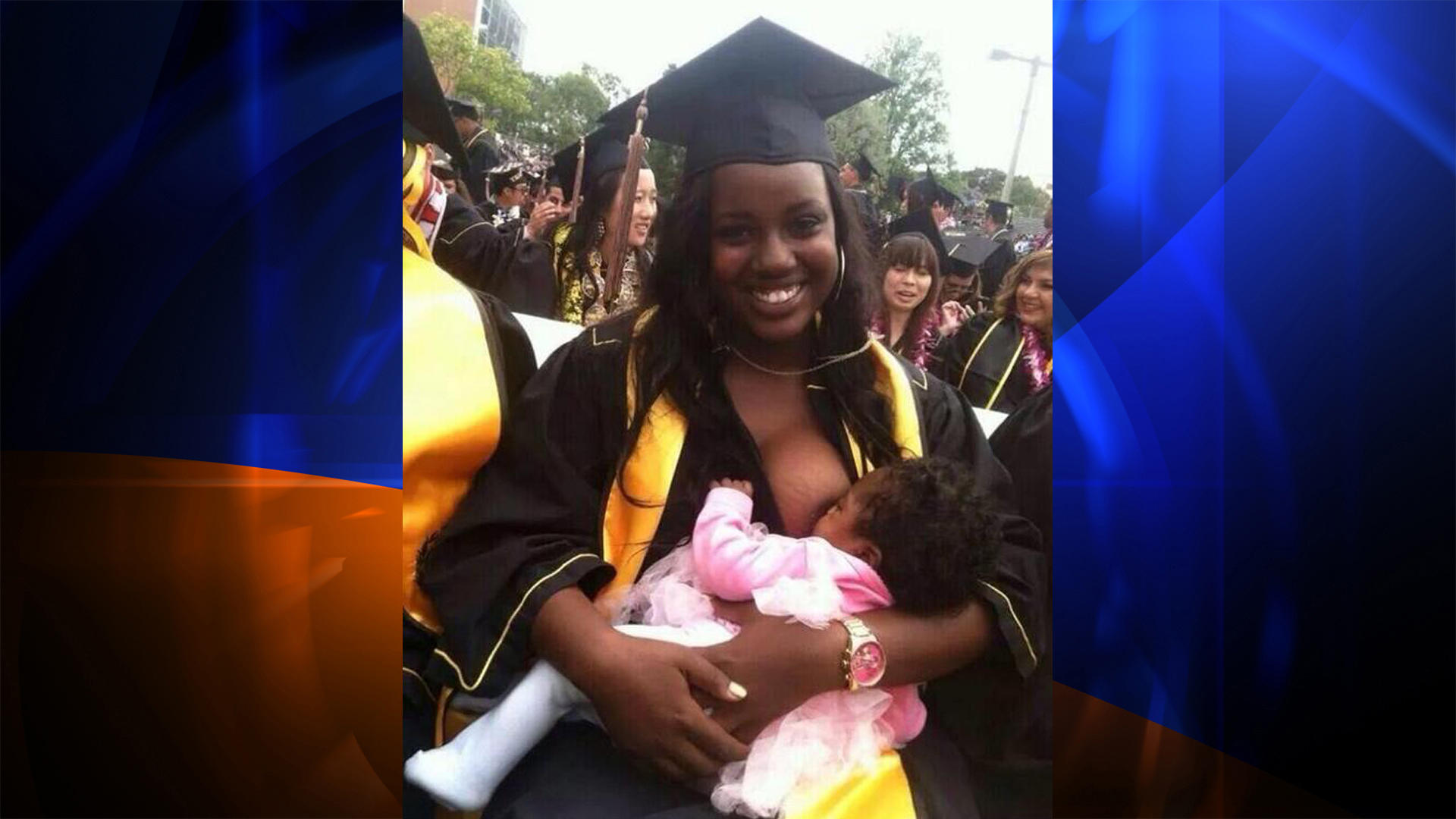
Breastfeeding Mom at College Graduation

Dear Dwonna:

What do you think about the woman who was photographed breastfeeding her baby at her graduation ceremony?

Signed,

Carly

——————————————

Dear Carly:

Here’s a brief background. On May 22, 2014, Karlesha Thurman received a degree in accounting from California State University, Long Beach, and after crossing the stage and returning to her seat, her friends said that they wanted to meet her daughter, Aaliyah. After getting her daughter from her mother, Thurman said that three-month-old Aaliyah “became fussy.” Thurman then began breastfeeding her daughter, without covering up and without apologizing.

“I did it to show it’s natural, it’s normal, there’s nothing wrong with it,” Thurman said. “I didn’t even know there was a big controversy about breastfeeding in public until all this happened,” she continued. A photo of Thurman breastfeeding at her graduation ceremony went viral, and some supported her while others condemned what to many people is a natural bonding experience between mother and child.

Let me first say that I have no children, and perhaps my choice to remain childless colors my views about this situation. However, simply because something is “normal” or “natural” does not automatically make it something that should be done in public. Would Thurman have changed her daughter’s smelly diaper in front of everyone if that had been the reason for her baby’s fussiness? After all, peeing and pooping are natural and normal, too, yet we expect parents to retreat to a private area when changing their child’s diapers.

May I ask why it would have been so difficult for Thurman to at least cover up while she breastfed? Why hadn’t she pumped earlier and used a bottle so not to have to whip out her breast and breastfeed around other students who just came to celebrate their graduation from Cal-State, Long Beach and not sit next to a baby and her breastfeeding mom? I imagine that somewhere in the building there was a bottle since Thurman’s baby had been in the care of her grandmother prior to her having retrieved her.

For some, Thurman’s “act” was a welcomed event, as pediatricians work to encourage more black women to breastfeed. Said Dr. Lori Feldman-Winter, a pediatrician at Cooper University Hospital in Camden, New Jersey: “It’s a wonderful image because it brings together the fact that’s she’s educated, and is going to be an educated professional, and black and choosing to breastfeed…. It’s just nice to have more and more role models of black women breastfeeding.”

Listen, it’s nice that Thurman wants this photo to dispel the stereotype that black women don’t breastfeed, but she doesn’t curry any favor to those who point out that being another black woman who has given birth out of wedlock fulfills another stereotype, too. I understand why more and more women of all colors are choosing to breastfeed in public, perhaps they are doing it as a protest or simply out of sheer necessity. I’m a proud feminist who does not want to “shame” mothers who choose to breastfeed in public, but what is so shameful about covering up when public breastfeeding really is the only option? 

*Here’s BETHANY KAVANAUGH’s opinion. SHE DISAGREES WITH ME….*

 While normalization of public breastfeeding is on the rise, there are still women who feel uncomfortable nursing in public for fear of judgment of others, and with the recent backlash against Ms. Thurman, it’s no wonder why. This woman was doing nothing but feeding her child, and it has erupted into a social media frenzy with both supporters and naysayers. Not only is the law on Ms. Thurman’s side, but she was only doing what is natural: feeding her hungry child.

Breastfeeding can become complicated. Sometimes baby can’t use a bottle (my 8-month-old breastfeeding baby still hasn’t figured out the concept of a bottle), and sometimes mothers don’t respond to breast pumps, sometimes babies just prefer the comfort that only a mother can give. Regardless of the reason why, it is nobody’s business but Ms. Thurman’s if she chooses to nurse her child, no matter where she chooses to do so.  Remember when people couldn’t even show their ankles in public?

Let’s consider this: unless you are 25-year-old Karlesha Thurman, this doesn’t affect you at all. Why is everyone getting so fired up about a woman feeding her baby? It’s sad that no one would even have batted an eye at her giving her infant a bottle, yet she has quickly become an internet sensation under fire for her healthy and natural choice. That picture was beautiful, in my opinion, and that’s about as far as I’ll go to worry about it. I’m so proud of her for finishing her degree with a kid. It’s hard to do. I graduated last spring with two toddlers and pregnant with number three. I start my graduate degree in the fall, and I’m nervous about juggling schoolwork and three crazy kids. I digress.

Let’s all get back to worrying about Rhianna walking the red carpet naked—I mean, wearing Swarovski crystals that show off her nipples, butt crack, and pubic area—and leave Thurman alone. Because for some people it’s totally okay for Rhianna to prance around naked in public for millions to see, yet some of these same people condemn Thurman for having simply nursed her baby in public. 

Priorities, people. Priorities.

Image

Target, Home Depot, Gun Control, and Open Carry Laws

Dear Dwonna:

What do you think about stores like Target and Home Depot allowing customers to openly carry guns?

Signed,

Alexander

——————————

Dear Alexander:

Here’s a little background for those who are unfamiliar with the controversy regarding Target and Home Depot and their “open carry” guns policy.

Moms Demand Action for Gun Sense in America, a national mom’s group that “advocates strong gun regulation,” persuaded Starbucks, Chipotle, Jack in the Box, Sonic Brands, and Dallas-based Brinker International (which owns Chili’s) to ask its customers not to openly carry their rifles into their restaurants. They next focused on Target stores after the group Open Carry Texas (which says that it is an “organization dedicated to the safe and legal carry of firearms openly in the State of Texas in accordance with the United Stats and Texas Constitutions and applicable laws”) staged several demonstrations to promote its agenda. Demonstrations also occurred at Target stores in Alabama, Ohio, North Carolina, Washington, Wisconsin, and Virginia.

Two weeks ago, about 150 “Open Carry” supporters gathered at a Home Depot parking lot in North Richland Hills—a Ft. Worth, Texas, suburb—to push their beliefs in the Second Amendment. Home Depot corporate spokesman Stephen Holmes told The Dallas Morning News that “while The Home Depot allows customers to carry legally permitted weapons into its stores, we do not allow solicitation or organizing by third parties on our property.”

In criticizing Open Carry Texas’ campaign, the NRA said, “Using guns merely to draw attention to yourself in public not only defies common sense, it shows a lack of consideration and manners.” The NRA has finally said something with which I can agree.

Target spokeswoman Molly Snyder said, “Target does not sell firearms or ammunition and, as it relates to this issue, we follow all state and federal laws.” However, Snyder would not respond when “asked if Target would request customers not bring guns into its stores.” “Gun extremists have been using Target stores to promote their agenda of intimidation,” Moms said. “American moms,” they said, “will not shop where our children and families—including our teens who work at Target—are not safe.”

What do I think about this? I have been to Target just twice since they announced in December 2013 that the credit and debit card information of as many as 40 million customers was compromised between November 27 and December 15, the busiest weeks of the Christmas shopping season. Target would later announce a few weeks later that “an additional trove of personal information—like email and mailing addresses—from some 70 million people had been exposed as well.” While twice I was willing to give Target another chance after their data breach, their decision not to prohibit the open carrying of rifles into their stores means that I will treat Target like I do Walmart—it will be a store that will never get my business.

While I’m not so naïve as to assume that people are not carrying weapons (concealed or not) when I go into other stores, too many people with mental health and/or anger issues are carrying weapons and putting all of us in danger. And, to the NRA who says that a good guy with a gun can stop a bad guy with a gun: it’s getting more and more difficult to distinguish between the good guys with a gun and the bad guys with a gun. This sad reality came to light this past Sunday. In Las Vegas, a couple who were bent on “starting a revolution” murdered two police officers who were eating lunch at Cici’s pizza, and then walked into a Walmart where they shot someone standing by the front door. This couple then committed suicide in what police are saying was a suicide pact.

The Las Vegas ambush precedes the shooting of two priests at the Mother of Mercy Mission Catholic Church in Phoenix, Arizona, in which one priest was killed and another left in extremely critical condition; a shooting at a high school outside of Portland, Oregon, in which a 15-year-old student and the gunmen were killed; a shooting at Seattle Pacific University in which a student was killed and two others were wounded; and Elliot Rodger’s mass murder of six innocent people (three were stabbed) in Santa Barbara, California. Few of us can forget what happened on December 14, 2012, at Sandy Hook Elementary in Newtown, Connecticut, where Adam Lanza shot and killed 20 children and 6 staff members before killing himself. There have been some 74 school shootings since Sandy Hook.

I could continue to list all of the incidents of gun violence in this country just in the last year, but that list would, unfortunately, get tiresome and repetitive.

Though fewer than 12 people die during a mass shooting, that is just a fraction of the 32,000 Americans who are killed by firearms. The fact is that in the United States some 33 people are killed every day by a gun, and of those 33, 7 are children. Some 33 people are dead because of a gun: Every. Single. Day. And, most of these shooters obtained their weapons legally. We have a gun problem in this county, and putting more guns into the hands of the “good guys” will not solve this bloodshed.

Immediately after learning that his son Christopher was one of the victims of Elliot Rodger’s shooting spree, father Richard Martinez chastised “craven, irresponsible politicians and the NRA” for this latest gun tragedy. “They talk about our rights,” Martinez said. “What about Chris’s right to live? When will this insanity stop? When will enough people say, ‘Stop this madness!’ Too many have died. We should say to ourselves, ‘Not one more!’”

The fact is that some people’s unhealthy obsession with guns and what they regard as their “right to openly carry” is quickly getting out of control.

 Image

I can’t stop the leaders at Target, Walmart, and other stores from prohibiting customers who want to openly carry their weapons, but I can choose not to spend my dollars at their stores. Though I don’t pretend to have the answers for what will end the murders of innocent Americans by people legally and illegally carrying guns, arming more people is hardly a viable solution. However, passing sensible gun control laws, requiring more stringent background checks, and shoring up this country’s mental health system are good places to start.